
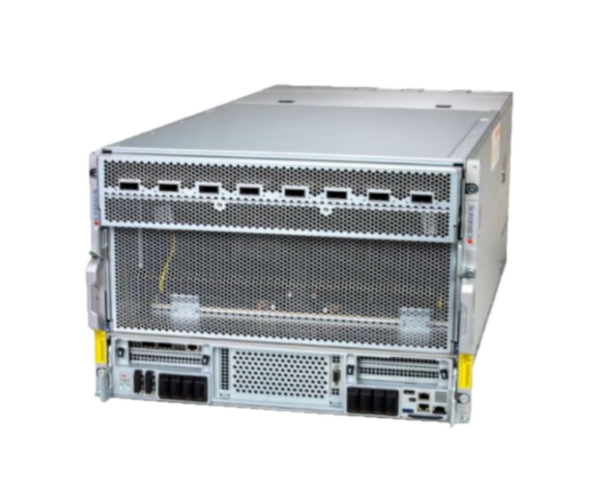
Supermicro A+ 8U Gold Series
AS-8126GS-NB3RT-01-G2
Eight NVIDIA Blackwell GPUs. 128 AMD EPYC cores. 3TB of DDR5-6400 RAM. One chassis. This is not an AI server — this is an AI datacenter compressed into 8U of rack space.
Executive Summary
The Supermicro A+ Gold Series AS-8126GS-NB3RT-01-G2 is the most computationally dense AI server available for enterprise purchase today. Combining dual AMD EPYC 9575F 64-core processors with the landmark NVIDIA HGX B300 NVL8 8-GPU module and an extraordinary 3TB of DDR5-6400 RAM, this 8U system annihilates every AI workload from LLM training to real-time inference. Its integrated 200GbE networking further eliminates the inter-node bandwidth bottleneck that plagues lesser platforms. The verdict: this is the closest thing to a portable AI supercomputer that money can buy — and it ships in 24 hours.
At a Glance
Premium Specification Table
Complete Technical Specifications
| Attribute | Technical Specification |
|---|---|
| Form Factor | 8U Rackmount / 1 Node |
| Processor (CPU) | Dual AMD EPYC™ 9575F (64-Core each, 128 Cores / 256 Threads Total, 3.30GHz, 256MB L3 Cache, 400W TDP) |
| Graphics (GPU) | 1× NVIDIA HGX B300 NVL8 Baseboard (8× Blackwell B300 GPUs) |
| System Memory | 3TB (24× 128GB) DDR5-6400 RDIMM ECC |
| Storage (Boot) | 2× 1.9TB M.2 Opal NVMe PCIe 4.0 SSD |
| Storage (Data/Cache) | 8× 7.68TB E1.S NVMe PCIe 5.0 SSD (1× DWPD) |
| Networking | 2× CX7 200GbE QSFP112 (NDR InfiniBand) + Onboard 10GbE RJ45 |
| CPU Platform | AMD EPYC™ 9005 Series (Turin / Zen 5c) |
| Target Workloads | LLM Training, GenAI, Conversational AI, HPC, Drug Discovery, Fraud Detection, Scientific Research, Autonomous Vehicles |
| Availability | Usually Ships within 24 Hours |
✓ Primary Strengths
- Eight Blackwell B300 GPUs in a single 8U NVL8 HGX baseboard — maximum AI compute density on the planet.
- 3TB of DDR5-6400 ECC RAM eliminates memory starvation even on the largest foundation models.
- Native 200GbE CX7 networking enables true multi-node scale-out without PCIe expansion card upgrades.
- 128 EPYC Zen 5c P-Cores process data pipelines at a rate that keeps all eight GPUs fully saturated.
- 61.4TB of PCIe 5 E1.S NVMe storage handles massive training datasets entirely on-node.
- Ships within 24 hours — bypasses typical 9–18 month HGX supply chain lead times.
✕ Key Constraints
- 8U chassis requires significant rack space and high-PDU power provisioning (200–240V dedicated circuits).
- Price point positions this squarely as an enterprise or research institution purchase, not a departmental buy.
- NVL8 GPU topology is optimized for training; pure inference-only workloads may find a 4U system more cost-efficient.
- Requires careful data center pre-planning for thermal management given extreme aggregate TDP.
🏆 Ready to benchmark this against your current cluster costs? Request a volume enterprise quote directly from Supermicro.
Request Enterprise QuoteReview Manuscript
The Definitive Deep-Dive: Why the Supermicro A+ 8U Gold Series is the Apex AI Server for 2026 Enterprise Deployments
The AI Factory era has matured. The question is no longer whether to build on-premise AI infrastructure, but how much compute you can deploy per rack unit while managing power density, thermal envelopes, and total cost of ownership. In 2026, that answer is written in silicon, and it is spelled Supermicro A+ Gold Series AS-8126GS-NB3RT-01-G2.
What you are looking at is an 8U chassis engineered around a single, extraordinary thesis: put the largest commercially available GPU cluster — NVIDIA’s HGX B300 NVL8 eight-GPU baseboard — inside a system architected with absolutely zero bottlenecks. Everything else: the dual AMD EPYC CPUs, the 3TB memory wall, the PCIe 5 storage fabric, the 200GbE NDR networking — exists in service of feeding that GPU array with an unceasing torrent of data.
GPU Architecture: The NVIDIA HGX B300 NVL8 Epoch
The centrepiece of the AS-8126GS-NB3RT is the NVIDIA HGX B300 NVL8 baseboard — a single PCB carrying eight Blackwell B300 GPUs interconnected via NVLink at extraordinary bandwidth. This is not eight independent GPUs loosely coupled over PCIe; it is a tightly-fused compute monolith that presents itself to the application stack as a single, unified pool of GPU memory and compute. For training large language models, diffusion models, or any graph-structured neural architecture, this NVLink topology is transformational.
The Blackwell B300 architecture introduces the FP4 Transformer Engine, a second-generation FP8 datapath, and a massively enlarged Tensor Core array capable of sustaining petaflop-class throughput on mixed-precision workloads. Combined with the NVL8 topology’s inter-GPU bandwidth, the entire baseboard functions as a single distributed matrix accelerator — precisely what modern LLM training and conversational AI inference demand.
CPU Platform: AMD EPYC Turin’s Zen 5 Supremacy
Feeding eight Blackwell GPUs requires a CPU platform with extraordinary I/O bandwidth, enormous memory channels, and a core count high enough to execute complex pre-processing, tokenization, and data-loading pipelines concurrently. Supermicro’s answer is dual AMD EPYC 9575F processors, each packing 64 Zen 5c cores at a 3.30GHz base clock with 256MB of L3 cache and a 400W TDP. The combined 128-core, 256-thread CPU complex delivers native PCIe 5.0 lane density sufficient to saturate both the NVL8 baseboard and the 8-drive E1.S NVMe array simultaneously.
For AI pipelines requiring CPU-side pre-processing — drug discovery molecular simulations, autonomous vehicle perception preprocessing, financial time-series feature engineering — these 128 cores are not an afterthought. They are a genuine supercomputer-class host processor.
Memory Subsystem: 3TB DDR5-6400 — The World’s Most Generous AI Server RAM
At 3TB total (24 × 128GB DDR5-6400 RDIMM ECC), the memory subsystem of the AS-8126GS-NB3RT is simply without peer in its class. Running at 6400 MT/s across the full channel width of the EPYC 9005 platform, this memory subsystem delivers hundreds of gigabytes per second of aggregate bandwidth. For AI workloads that require keeping enormous batches of training data in system RAM for rapid iterative access — LLM fine-tuning, scientific simulation state, real-time analytics for fraud detection — this 3TB allocation means you almost never page to storage. The result: deterministic, low-latency training loops.
💡 Running memory-intensive analytics or LLM training at scale? This system’s 3TB of DDR5-6400 eliminates your RAM bottleneck entirely.
Configure & PriceStorage Fabric: Dual-Tier NVMe for Massive Dataset Scale
The storage configuration is engineered for genuine enterprise AI workloads. Eight 7.68TB E1.S NVMe PCIe 5.0 drives provide approximately 61.4TB of ultra-fast data-tier storage, delivering millions of IOPS and sequential throughputs that can sustain the read bandwidth of eight Blackwell GPUs during training. Two 1.9TB M.2 Opal NVMe PCIe 4.0 drives serve as the encrypted boot and OS environment. Together, this two-tier architecture means training datasets for even 70B+ parameter models can be staged entirely on-node — eliminating the NFS/NAS dependencies that introduce unpredictable latency spikes in many enterprise clusters.
Networking: 200GbE Native — No Upgrade Required
Perhaps the single most significant engineering advantage the AS-8126GS-NB3RT holds over competing platforms is its native 200GbE CX7 networking. Two Mellanox ConnectX-7 NICs with QSFP112 interfaces deliver 400Gbps total throughput over NDR InfiniBand/RoCEv2 out of the box. Multi-node AI/ML training clusters can be assembled without purchasing supplemental DPU cards or network adapters — this system is cluster-ready from day one. For organisations scaling from a single node to a 10-node AI supercluster, the networking is already there.
Thermal and Power Engineering
The engineering challenge of cooling 128 EPYC cores and eight Blackwell GPUs in an 8U chassis is formidable. Supermicro’s solution leverages its mature proprietary airflow channelling technology with hot-swappable redundant fans engineered for high-TDP GPU baseboard configurations. The chassis is designed to accept the thermal output of the NVL8 module’s passive coolers by ensuring precisely directed, high-volume airflow. Facilities teams should plan for 200–240V, 30A+ PDU provisioning and validate rack thermal capacity before deployment.
Real-World Applications
Who Should Deploy This System?
Drug Discovery & Life Sciences
Protein folding, molecular dynamics, and genomic sequencing at throughputs previously requiring multi-rack HPC clusters.
LLM Training & GenAI
Train or fine-tune 7B–70B parameter models on proprietary enterprise data with full privacy on-premise.
Conversational AI at Scale
Serve thousands of concurrent API inference requests with sub-50ms latency for internal or customer-facing AI assistants.
Autonomous Vehicle R&D
Simulate sensor fusion, perception stack training, and safety validation in real time across massive scenario libraries.
Finance & Fraud Detection
Real-time graph neural network inference on transaction streams for sub-millisecond fraud scoring at banking scale.
Scientific HPC
Computational fluid dynamics, climate modelling, and physics simulations that demand both FP64 and mixed-precision throughput.
Technical FAQ
Your Questions, Answered
What makes the NVIDIA HGX B300 NVL8 so powerful for AI training?
How many total CPU cores does the AS-8126GS-NB3RT-01-G2 feature?
Is the built-in 200GbE networking sufficient for multi-node AI clusters?
What storage is included and can it hold a 70B+ parameter training dataset?
What are the power and facility requirements for this system?
What verticals is the AS-8126GS-NB3RT designed for?
Can this system handle real-time AI inference as well as training?
Final Verdict
The Undisputed Apex of Enterprise AI Infrastructure
The Supermicro A+ Gold Series AS-8126GS-NB3RT-01-G2 is, without qualification, the most capable single-node AI server commercially available in 2026. Its combination of eight Blackwell B300 GPUs on an NVL8 baseboard, 128 AMD EPYC Zen 5 cores, 3TB of DDR5-6400 RAM, 61TB of PCIe 5 NVMe storage, and native 200GbE CX7 networking creates a system with zero significant architectural bottlenecks. Every component is chosen to keep the GPU array fully saturated at all times. For enterprises in drug discovery, financial AI, LLM development, or autonomous systems research, this is not a purchasing decision — it is a competitive necessity.